
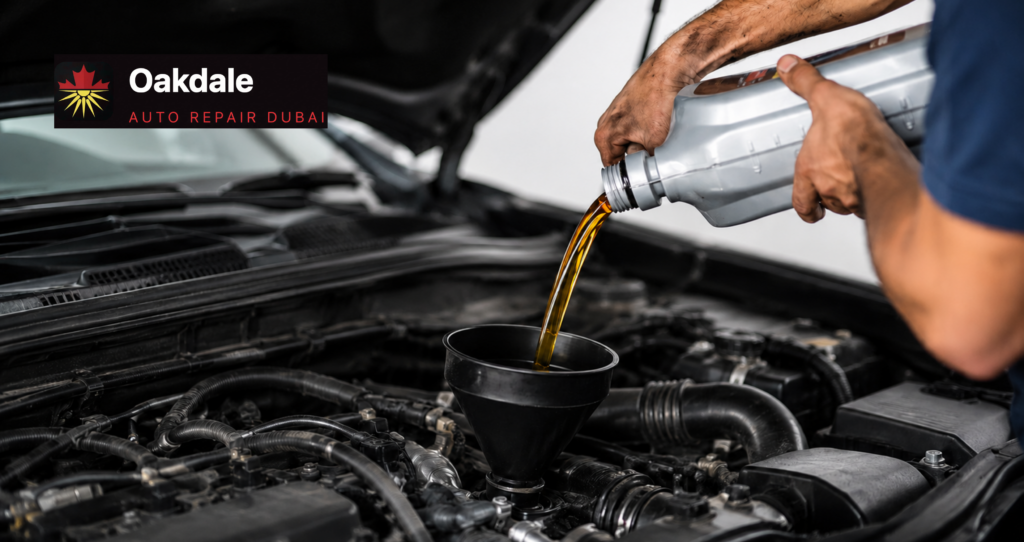
Walk into an automotive shop and you may see bottles marked 0W-20, 5W-30, 5W-40 or 10W-40. To many drivers, these numbers look like different levels of oil quality.
They are not.
The numbers on car engine oil describe its viscosity characteristics at different temperatures. Viscosity refers to how readily a fluid flows. Your engine needs oil that can circulate appropriately during start-up while maintaining the characteristics required once the engine reaches operating temperature.
The important point is that a higher number does not automatically mean “better”, and Dubai’s hot climate does not mean every car should use thicker oil.
Decode the Label: What Does 5W-30 Mean?
Take 5W-30 as an example.
The first part, 5W, describes the oil’s low-temperature viscosity classification. The “W” refers to winter-grade performance.
The second number, 30, describes its viscosity classification at higher engine operating temperatures.
So the label is telling you how the lubricant behaves across different temperature conditions.
This is why 0W-30 and 5W-30 are not identical even though both carry the same second number.
Oakdale’s guide to engine oil changes and maintenance explains why using the right oil and changing it according to the vehicle’s requirements matters for long-term engine care.
Not Sure Which Oil Grade Your Engine Needs?
Oakdale Auto Repair can check the required oil specification for your exact vehicle rather than choosing a lubricant based only on the number printed on the bottle.
Call or WhatsApp +971 55 599 1234
Visit 29th St, Al Quoz Industrial Area 4, Dubai
Website: https://oakdaleautodubai.com/
Does a Higher Number Mean Better Engine Protection?
No.
The viscosity grade is not a quality ranking.
A 10W-40 is not automatically superior to a 5W-30, just as a 0W-20 is not automatically inferior because its numbers are lower.
Engines are designed around specific clearances, oil-flow requirements and lubrication systems. Modern engines may also use oil pressure to operate variable valve timing and other systems.
Using oil that is significantly different from the manufacturer’s requirement can affect how the lubrication system operates.
The correct choice is the oil approved for your particular engine.
“Dubai Is Hot. Should I Use Thicker Oil?”
This sounds logical, but it can lead drivers in the wrong direction.
Dubai’s heat certainly places additional demands on vehicles. However, modern engines are designed and tested to operate with particular oil grades and specifications across defined conditions.
A car manufacturer may approve a relatively low-viscosity oil even for vehicles operating in hot climates.
Oakdale’s guide to how Dubai heat affects your car explains why local temperatures matter for maintenance without making heat the automatic explanation for every vehicle concern.
Do not move from 0W-20 to 10W-40 simply because the second oil appears “thicker” and Dubai is hot.
Thinking of Changing Oil Grade Because of the Weather?
Oakdale Auto Repair can check the manufacturer requirements before your next service and help avoid experimenting with a viscosity that may not suit the engine.
Call or WhatsApp +971 55 599 1234 or bring your vehicle to 29th St, Al Quoz Industrial Area 4, Dubai.
Viscosity Is Only Part of the Oil Specification
Here is where engine-oil labels become more important.
Two bottles can both say 5W-30 while meeting different technical or manufacturer specifications.
Modern engine oils can be designed around requirements relating to:
- Engine wear protection
- Deposit control
- Turbocharger operation
- Emissions-system compatibility
- Oxidation resistance
- Manufacturer-specific approvals
That means choosing oil based only on 5W-30 or 0W-20 can still result in the wrong lubricant.
A proper car service in Dubai should consider both the viscosity grade and the correct specification required for the vehicle.
What About Fully Synthetic Oil?
“Fully synthetic” describes aspects of the lubricant’s formulation. It does not replace the viscosity grade or manufacturer specification.
You can find fully synthetic oils in several different viscosity grades.
So the statement “my car uses synthetic oil” is not specific enough to select the correct product.
The useful questions are:
What viscosity does the engine require?
For example, 0W-20 or 5W-30.
What specification or approval is required?
This depends on the vehicle and engine.
Both need to be correct.
Can You Switch From One Viscosity to Another?
Only when the vehicle manufacturer allows it.
Some engines may have more than one approved viscosity depending on model, engine variant or operating conditions. Others have much more specific requirements.
Do not change viscosity because:
- A friend uses another grade
- The car has high mileage
- Dubai is hot
- Another oil is cheaper
- The oil pressure “seems low”
- A thicker oil sounds more protective
If there is an oil-pressure or oil-consumption problem, changing viscosity without diagnosing the cause can hide the symptom rather than solve it.
What Happens If the Wrong Oil Is Used?
The result depends on the engine and how different the oil is from the required specification.
An unsuitable oil may affect:
- Oil circulation
- Oil-pressure behaviour
- Lubrication during start-up
- Oil-controlled engine systems
- Overall engine protection
That does not mean one incorrect top-up automatically destroys an engine. It means there is little reason to guess when the correct specification is available.
If you suspect the wrong oil was used during a previous service, have the oil requirement confirmed rather than trying another random grade.
Oil Warning or Unusual Engine Noise After Servicing?
A new warning or change in engine behaviour deserves inspection rather than another oil experiment. Oakdale Auto Repair follows a diagnosis-first approach before recommending maintenance or repair.
Call or WhatsApp +971 55 599 1234.
Check the Oil Level Between Services Too
Correct viscosity does not help if the oil level becomes too low.
Where applicable, check the engine oil according to the manufacturer’s procedure. Some vehicles have a dipstick, while others use electronic oil-level monitoring.
Watch for:
- Repeated oil-level loss
- Oil underneath the vehicle
- Burning-oil smells
- Oil-pressure warnings
- New engine noises
A broader car inspection in Dubai can help when oil concerns appear alongside warning lights, leaks or other symptoms.
FAQs
What do car engine oil numbers mean?
The first number and W indicate the oil’s low-temperature viscosity classification. The second number describes its viscosity classification at higher operating temperatures.
Is 5W-40 better than 5W-30?
Not automatically. They have different high-temperature viscosity grades. The better oil for your vehicle is the one that meets the engine manufacturer’s approved viscosity and technical specification.
Should I use thicker engine oil in Dubai?
Not simply because Dubai is hot. Follow the manufacturer-approved oil requirements for your engine. Modern vehicles can be designed for lower-viscosity oils even in high-temperature markets.
Is fully synthetic oil always better for my car?
Your vehicle should use the type and specification required by its manufacturer. “Fully synthetic” alone does not tell you whether the oil has the correct viscosity or technical approval.
Can I mix different engine oil viscosities?
Routine mixing is not a good maintenance strategy. If an emergency top-up is necessary, refer to manufacturer guidance. At normal servicing, use the correct approved lubricant.
Where can I get the correct car engine oil in Dubai?
Oakdale Auto Repair in Al Quoz Industrial Area 4 provides oil-and-filter servicing across multiple makes, including European and luxury vehicles, using the appropriate vehicle requirements.
Read the Oil Label as an Engine Requirement, Not a Ranking
Engine oil numbers are there to describe viscosity behaviour, not to tell you which bottle is “best”.
The correct oil combines the appropriate viscosity with the technical specification required by your particular engine. That matters more than simply choosing the thickest, most expensive or most familiar product on the shelf.
Confused by 0W-20, 5W-30 or Another Oil Grade?
Oakdale Auto Repair can identify the correct lubricant requirement before your next oil-and-filter service. The 3rd-generation Canadian-owned family workshop brings more than 30 years of automotive experience across multiple vehicle makes.
Call or WhatsApp +971 55 599 1234
Visit 29th St, Al Quoz Industrial Area 4, Dubai
Instagram: @oakdaleautorepair